The Dance of Stillness and Flame
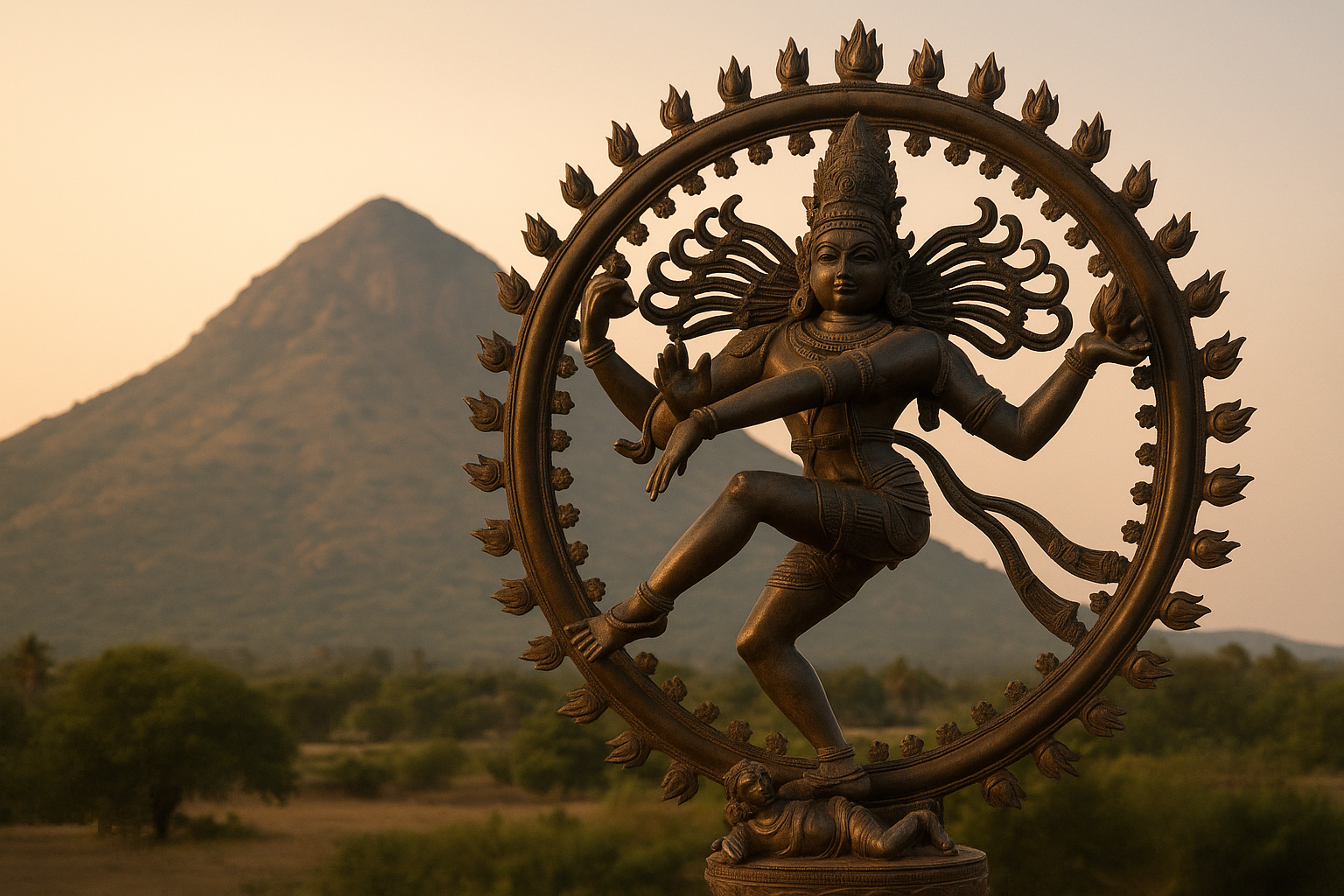
At Arunachala, the mountain of fire, Shiva is still.
In Chidambaram, as Nataraja, Shiva dances.
The silent flame and the cosmic rhythm — one unmoving, the other dynamic — yet both reveal the same truth.
Shiva, the supreme awareness, expresses himself as both the Dancer and the Mountain. Movement and stillness — not opposites, but reflections of the same grace
Nataraja’s dance reflects the five eternal acts of cosmic rhythm:
Padaiththal(படைத்தல் ) – Creation – Life begins – உயிரின் ஆரம்பம்
In Nataraja’s right upper hand, he holds the “Udukai” (உடுக்கை) — a small hourglass-shaped drum. This is no ordinary instrument. It represents sound (ஒலி) — not noise, but primordial vibration, the first pulse of creation.
Sound is the seed from which form arises
The vibration of the Udukai is said to be the source of the Tamil letters, the origin of language, breath, and being
It is not noise (சத்தம்), which is random and chaotic
It is sound with awareness, rhythm, and intent — the music of the cosmos
“In the beginning was sound. Not seen, but heard.”
This is why Shiva’s dance doesn’t begin in silence—it begins with the sound that births all silence and movement alike.
Azhiththal (அழித்தல் ) – Dissolution – Life returns to source – உயிர்கள் தங்கள் மூலத்திற்கு திரும்பும் தருணம்
In Nataraja’s upper left hand, he holds the Agni (அக்னி) — the divine fire. This is the fire of dissolution, of transformation, not destruction in the ordinary sense.
- Fire is not an end — it is a return to essence
- Just as wood becomes flame and smoke, form dissolves into formlessness
- This is the purifying force of Shiva — burning away illusion, ego, and attachment
- In this gesture, Shiva reminds us: what is born must return; what appears must vanish
“The flame in his hand is not cruel — it is cleansing.”
Through this fire, life does not end — it evolves, it transforms, it renew
Kaaththal (காத்தல் ) – Preservation – Life is held in balance – உயிரை சீராக தாங்கும் கரம்
Nataraja’s lower right hand is shown in the Abhaya Mudra — the gesture of protection, reassurance, and preservation.
- This hand says: “Do not fear.”
- It signifies Shiva’s compassion — his willingness to sustain all that is born
- As creation and dissolution unfold, this is the balancing force
- Preservation is not mere survival — it is grace in motion, life held with love
Nataraja’s lower left hand gestures gracefully across the chest, with fingers pointing downward toward his raised left foot.
This is no random gesture — it conveys a hidden truth Thus, this hand both veils and reveals.
“In the cosmic dance, there is chaos and rhythm — but this hand holds us steady.”
This mudra reminds us that the universe is not abandoned — it is gently cradled in divine assurance.
Maraiththal (மறைத்தல் ) – Veiling – The play of illusion hides the truth – உண்மையை மறைக்கும் மாயையின் திரை
The fourth divine act of Nataraja’s dance — Maraiththal (Veiling) — Shiva reveals how ignorance conceals the Self. But he does more than just show it — he subdues it.
- Under his right foot, Shiva crushes the head of Muyalagan (Apasmara) — the dwarf of ego, delusion, and forgetfulness
- Muyalagan represents that part of us which resists truth, clings to false identity, and feeds illusion
- Shiva does not kill him — he presses him down
Because ignorance cannot be destroyed once and for all — it must be constantly kept in check
- The lower left hand, in gajahasta gesture, points toward this act, not to the air, but to the foot on Muyalagan’s head
“Truth is not hidden by the world — it is hidden by the ego beneath your own feet.”
Arulal (அருளல் ) – Grace – The Lord bestows wisdom to transcend – விடுதலையை அளிக்கும் உயர்ந்த பாதம்
In Nataraja’s dance, the raised left foot is not just a gesture of beauty — it is a powerful symbol of divine grace and liberation.
- While the right foot subdues ignorance, the left foot is lifted high — offering mukti, freedom from illusion and rebirth
- This foot is not on the ground, because grace is not bound by the world — it lifts us above it
- The lower left hand’s arc draws our eyes to this foot, which is not merely shown — it is offered to the seeker
- To reach it, one must pass beyond fear, illusion, ego, and surrender fully to the dance of the Lord
“This foot is refuge. This is where the dance ends and liberation begins.”
If Chidambaram is where Shiva dances, Arunachala is where Shiva remains — a mountain of silent fire.
One is dynamic … The other is unmoving …Both are sacred
Arunachala is Nataraja in repose — the stillness after the dance
"தக்கன் வேள்வி அழித்த சிவனே, - Shiva, who burned down the sacrificial fire of Daksha (Thakkan), standing against ego and false pride
தடமலர் சோதியில் நடம் புரியும் தெய்வமே, - Divine One who dances in a blaze radiant like blossomed lotus petals
அடங்காத அறுமுக வலிமை கொண்டருள்வாயே, - Bestow us the strength that cannot be contained
அருணை அடைவோம் அருள் தரும் நடராஜனே!" - Nataraja, who showers grace — may we reach Arunai (Tiruvannamalai), Your sacred abode
— திருநாவுக்கரசர் (அப்பர்), தேவாரம் – Thirunavukarasar (Appar ) ,Thevaram

Arunai is an ancient name for Tiruvannamalai, used in many Tevaram hymns by Appar, Sundarar, and Sambandar. In Tevaram, Arunai is often used interchangeably with Annamalai, Tiruvannamalai, and Sonachalam.
At Arunamangala: Experiencing the Inner Dance
Sit before the mountain in stillness
Reflect on the inner dance of transformation
Let silence become rhythm, and breath become prayer
“When the heart is quiet, the inner Nataraja begins to move.”
 about us
Leave a comment